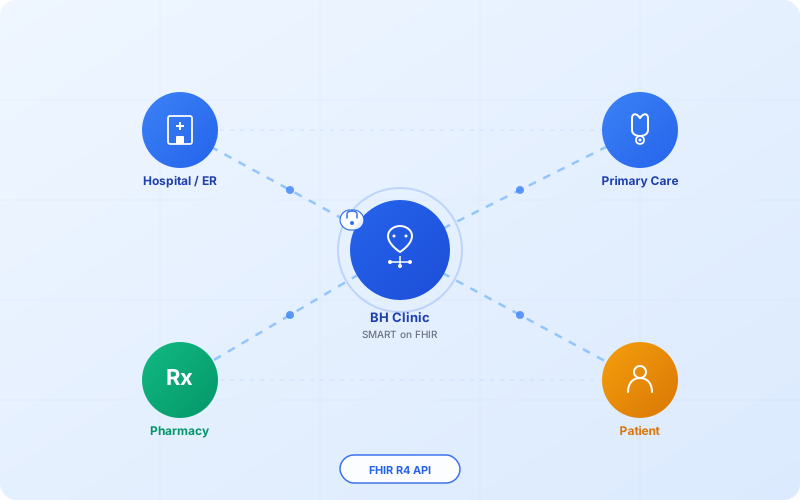
Whom this is for: Practice Owners, Clinical Directors, and Operations Leads at small clinics (1-20 providers) who need to share data with hospitals, PCPs, specialists, and payers but feel stuck in a silo. Behavioral health and SUD programs face extra hurdles - those are called out throughout.
Disclaimer: This content is for educational purposes only. Confirm interoperability requirements with your compliance and IT teams.
Quick definitions: FHIR (Fast Healthcare Interoperability Resources) is the modern standard for exchanging healthcare data electronically. SMART on FHIR is a framework that lets third-party applications plug into any EHR that supports it, like apps on a smartphone. HIE = Health Information Exchange.
TL;DR
- Most small clinics operate as "referral islands" - sending faxes, making phone calls, and hoping information arrives.
- The root cause: Legacy systems weren't designed for small-practice data sharing, and staff learn to work around them instead of through them.
- The way out: SMART on FHIR gives you standards-based, app-level interoperability without ripping out your infrastructure.
The "Referral Island" Problem
Small clinics occupy a tough spot in the care continuum. Your patients move between your practice, hospitals, specialists, labs, pharmacies, and ERs. Yet smaller practices are often the least connected node in that chain - especially in behavioral health, where privacy regulations add an extra layer of complexity.
The result? Providers fly blind. A patient shows up at the ER, and the ER physician has no visibility into their current medications, active treatment plan, or risk factors. Meanwhile, your clinicians never learn what happened during that ER visit until the patient (maybe) mentions it weeks later.
This is not a technology limitation - it's an integration gap. And it's solvable without a six-figure IT project.
Why "Just Connect to the HIE" Isn't Enough
Many clinics are told that joining their regional Health Information Exchange will solve interoperability. HIEs are valuable, but they have real limits - especially for smaller practices:
Problem: Document-Level Sharing
What happens: Most HIEs exchange C-CDA documents (big XML bundles). They share "everything or nothing" - which makes it hard to control what goes out.
The impact: Practices either opt out of the HIE entirely (data silo) or participate and risk sharing records they shouldn't. For BH/SUD programs, this directly collides with 42 CFR Part 2 consent requirements.
Problem: One-Way Data Flow
What happens: HIE connections are often configured for hospitals to push data out. Smaller clinics receive, but rarely contribute back.
The impact: The referring provider or ER never gets your treatment updates, defeating the purpose of "interoperability."
HIEs solve part of the puzzle, but small clinics need application-level interoperability - the ability for specific apps and workflows to read and write discrete data elements, with access controls built in.
Enter SMART on FHIR
SMART on FHIR is the closest thing healthcare IT has to a universal app platform. It works like this:
- Your EHR exposes a FHIR API - a standardized way for other software to request specific data (e.g., "give me this patient's active medications").
- Third-party apps authenticate through your EHR using OAuth2, the same protocol your bank uses for login.
- Scopes control access - each app only gets permission to see the data categories you approve (e.g., medications yes, psychotherapy notes no).
- Everything is auditable - your system logs which app accessed what data, when, and for whom.
For a small clinic, this means you can:
- Give patients access to their own records through a standards-based portal
- Accept referrals electronically with structured data instead of faxed PDFs
- Send care summaries to another provider's EHR in a format they can actually import
- Let a care coordination app pull a patient's medication list while respecting access scopes (BH clinics can exclude therapy notes, for example)
What "Good" Looks Like: A Practical Scenario
Before: The Fax Workflow
1. Patient finishes treatment at your clinic.
2. Front desk prints a summary, manually reviews it for sensitive content, and faxes it to the referring provider.
3. The receiving office scans it into their EHR as a PDF blob. Maybe it sits in a pile.
Result: 3-5 days of latency. No structured data. No confirmation of receipt.
After: SMART on FHIR Workflow
1. Clinician clicks "Send Care Summary" in the EHR.
2. System auto-generates a FHIR-based summary with the appropriate data elements (meds, diagnoses, care plan). BH clinics can apply consent-driven segmentation to exclude restricted notes.
3. Summary is transmitted to the receiving provider's system via FHIR API. It arrives as structured, importable data.
Result: Seconds, not days. Discrete data. Auditable.
Three Interoperability Patterns That Work for Small Clinics
You don't need to implement everything at once. Start with the pattern that matches your biggest pain point:
Pattern 1: Patient Access (Easiest Win)
Give patients API-based access to their own records. This is already required by the ONC Cures Act.
-
What it solves:
Patients can use any SMART-enabled app to view their medications, lab results, and care plans - without calling your front desk. -
Specialty consideration (BH/SUD):
Your FHIR API must respect segmentation. If a patient has opted to restrict certain SUD records under 42 CFR Part 2, those restrictions should carry through to API responses.
Pattern 2: Provider-to-Provider Data Exchange
Enable your clinic to send and receive structured clinical data with hospitals, PCPs, and specialists.
-
What it solves:
Eliminates the fax-and-scan loop. Referring providers get discrete, importable data (medication lists, active diagnoses, care team info). -
Specialty consideration (BH/SUD):
Consent directives must travel with the data. FHIR security labels and the Consent resource let you tag exactly which segments are shareable and under what conditions - critical for 42 CFR Part 2 compliance.
Pattern 3: Third-Party App Integration
Let specialized apps (clinical decision support, care coordination tools, outcome trackers, screeners) plug directly into your EHR.
-
What it solves:
You don't have to build every feature yourself. Vetted SMART apps can read context from your EHR, run their logic, and write results back - all within your security perimeter. -
Specialty consideration (BH/SUD):
Scope governance is critical. Your EHR should let you control exactly which FHIR resources each app can access - and log every interaction for audit. BH clinics should verify that restricted data categories (e.g., SUD notes) are excluded from app scopes by default.
What to Ask Your EHR Vendor
If you're evaluating EHR systems (or pushing your current vendor), these are the questions that separate real interoperability from brochure claims:
Vendor Evaluation Checklist
Ask these questions before signing (or renewing) any EHR contract.
-
Do you support SMART on FHIR app launch?
Not just "FHIR API" - specifically the SMART App Launch framework. This is what lets third-party apps authenticate and run in context. -
Which US Core profiles do you support?
US Core is the baseline data standard. Your vendor should support the current version and be able to tell you exactly which profiles (Patient, Condition, MedicationRequest, etc.) are implemented. -
How do you handle consent-based data segmentation in API responses?
Any practice may need to restrict certain data elements from API responses. This is essential for BH/SUD programs under 42 CFR Part 2, but also relevant for practices handling sensitive reproductive health, HIV, or adolescent records. The API should filter at the resource level, not just the document level. -
Can I see audit logs for all API access?
Every external app request should be logged with the app identity, user context, scopes granted, and resources accessed. This is essential for compliance.
Next Steps
Interoperability is not a one-time project - it's a capability you build incrementally. Start here:
- Audit your current data flows. Map the top 5 places you send or receive patient information today. How much is fax? How much is phone? How much is electronic?
- Identify your highest-friction handoff. The referral that takes the longest, drops the most data, or causes the most callbacks - that's your first interoperability target.
- Ask your vendor the questions above. If they can't answer clearly, that tells you something important about your platform's readiness.
Want to see real SMART on FHIR interoperability?
ChartSynergy is built on FHIR from the ground up - not bolted on as an afterthought. Our interoperability capabilities include:
- SMART App Launch: run third-party apps directly inside the EHR with full scope governance.
- US Core FHIR API: standards-based data exchange that works with any compliant system.
- Consent-aware responses: API queries respect patient consent directives and segmentation rules automatically.
Note: Interoperability outcomes depend on participating systems and organizational configuration.
Request an Interoperability DemoRelated Topics
- All Resources
- Behavioral Health Hub
- 42 CFR Part 2 Guide
- Patient Portals & Privacy (Coming Soon)